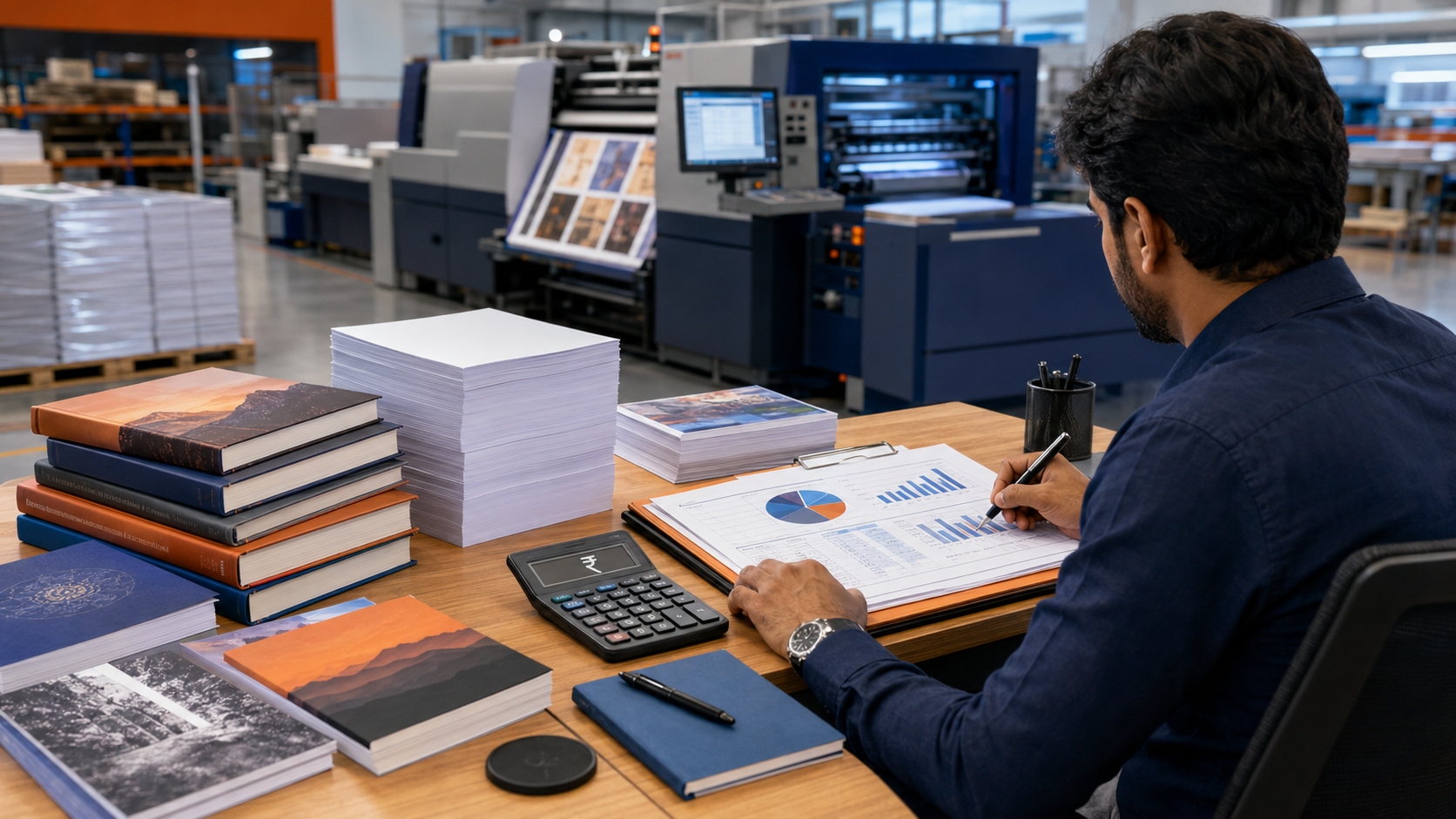
Calculating the exact cost of book printing is one of the most important steps for publishers, authors, educational institutions and businesses. The final printing price does not depend only on the number of copies. Several factors, including page count, paper quality, book size, binding method, colour requirements and finishing options, influence the total cost.
Understanding these factors can help you plan your budget, select the right printing method and avoid unexpected expenses. This guide explains the major elements used to calculate the real cost of book printing in India.
1. Number of CopiesThe required quantity has a major impact on the cost per book. In most cases, increasing the number of copies reduces the cost per copy because setup and production expenses are distributed across a larger print run.
- 1–100 copies: Suitable for print-on-demand and digital printing.
- 100–1,000 copies: Digital or short-run production may be suitable.
- 1,000+ copies: Offset printing may provide a lower cost per copy.
Publishers should avoid printing unnecessarily large quantities only to get a lower unit price. Unsold books create additional storage and inventory expenses.
2. Total Number of PagesThe page count directly affects paper consumption, ink usage, printing time and binding cost. A 300-page book will naturally cost more than a 100-page book with the same specifications.
Before requesting a printing quotation, confirm the final number of pages. Even small changes in page count can affect the total production cost, especially when thousands of copies are being printed.
3. Book SizeThe dimensions of the book determine how efficiently its pages can be arranged on a printing sheet. Standard sizes generally provide better paper utilisation and help reduce waste.
Common book sizes include:
- A4 – 210 × 297 mm
- A5 – 148 × 210 mm
- 5.5 × 8.5 inches
- 6 × 9 inches
- 8.5 × 11 inches
Custom sizes can make a book look distinctive, but they may increase trimming waste and production expenses. Discuss the dimensions with your printing partner before finalising the book design.
4. Paper Type and GSMPaper is one of the largest components of book production cost. Its price depends on the type, thickness, finish, brightness and availability.
Frequently used paper options include:
- Natural shade paper for novels and general books
- Maplitho paper for educational and text-based books
- Coated paper for catalogues and image-heavy publications
- Art paper for premium colour books
GSM means grams per square metre and indicates the weight of the paper. Higher GSM paper is generally thicker and more expensive. However, selecting the highest GSM is not always necessary. The paper should match the book’s purpose, expected durability and target selling price.
5. Black-and-White or Colour PrintingBlack-and-white printing is usually more affordable than full-colour production. Novels, academic books and manuals often use monochrome inner pages with a colour cover.
Children’s books, photography books, magazines and product catalogues may require full-colour printing. If only a few pages need colour, ask whether the colour sections can be printed separately. This can help control the overall cost.
6. Binding MethodBinding affects the appearance, strength, usability and price of a book. The right method depends on page count, book type and expected lifespan.
- Perfect binding: Commonly used for paperback books.
- Saddle stitching: Suitable for thin booklets and magazines.
- Hardcase binding: Used for premium and durable books.
- Spiral binding: Suitable for manuals, notebooks and training material.
- Section sewing: Provides greater strength for frequently used books.
Premium binding increases production costs but may also improve the perceived value and durability of the final product.
7. Cover and Finishing OptionsA professionally finished cover can make a book more attractive and protect it from regular wear. However, every additional finishing process affects the final quotation.
Popular cover-finishing options include:
- Gloss or matte lamination
- Spot UV coating
- Embossing and debossing
- Foil stamping
- Textured or speciality paper
- Dust jackets for hardcover books
Use premium finishing strategically. Adding too many effects may increase the cost without providing a proportional improvement in sales.
8. Prepress and Design ExpensesBook production also involves prepress work. This may include cover design, typesetting, page formatting, image correction, proofreading, colour management and preparation of print-ready PDF files.
Files that are not properly formatted can cause delays and additional correction charges. Before submitting a book, check the bleed, margins, image resolution, embedded fonts, page sequence and colour settings.
9. Packaging, Delivery and TaxesA printing quotation may not always include packaging, transportation, insurance and applicable taxes. These costs become especially important when books must be delivered to multiple cities or locations.
Always confirm whether the quotation includes GST, packing, loading, freight and final delivery. This will help you compare printing quotations accurately.
Simple Book Printing Cost FormulaA basic method for estimating the total cost is:
Total Printing Cost = Paper Cost + Printing Cost + Binding Cost + Finishing Cost + Prepress Cost + Packaging + Delivery + Applicable Taxes
The approximate cost per copy can then be calculated using:
Cost Per Book = Total Production Cost ÷ Total Number of Copies
For example, if the complete production cost of 1,000 books is ₹80,000, the approximate printing cost per book will be ₹80. Marketing, distribution, storage and royalty expenses should be calculated separately when deciding the selling price.
How to Reduce Book Printing Costs- Use standard book dimensions.
- Finalise the manuscript before production begins.
- Select paper according to the actual requirement.
- Use print-on-demand for uncertain demand.
- Avoid unnecessary finishing processes.
- Compare quotations using identical specifications.
- Request a physical sample before approving a large print run.
- Choose digital or offset printing according to the quantity.
The real cost of book printing in India depends on much more than the number of copies. Paper, page count, dimensions, colour, binding, finishing, design, packaging and delivery all influence the final price.
A professional printing partner can help you select the most economical production method without compromising quality. Edit One International provides modern book-printing and production solutions for publishers, authors, institutions and businesses.
Planning to print your next book? Contact Edit One International for professional guidance and a customised printing quotation.
Call or WhatsApp: +91-9871852545